Blog

  • Coworking 101 : The Future of Work – Coworking

    Coworking 101 : The Future of Work – Coworking

    Episode 1

    Coworking is not new

    Contrary to popular belief, Coworking is not a new concept or idea. In fact, the first books that extolled the virtues of Coworking first appeared in the 1600s. Since then, the only thing about the concept that hasn’t changed is probably its primary definition – ‘People working together’. What has changed, though – is to include the who’s, the why’s, the how’s and the where’s.

    Who are Coworkers?

    It is not surprising that Coworking grew in popularity in the late 80s and mid-90s, with the emergence of the digital and computer age. Coworking grew in line with the development of knowledge-intensive industries and the rise of creative work. With more individual-focused talents powered by accessible tools (computers and micro-machines), professionals converge in shared spaces to collaborate, support one another and economise on shared resources and amenities. Early coworkers included freelancers, creative professionals, game developers, programmers and others.

    Why Cowork?

    One of the biggest benefits of Coworking is social. So naturally, people in creative and entertainment industries enjoy connecting and relationship building – they thrive in coworking environments. In other ways, introverts and programmers (who are less likely to socialise) rely on Coworking because it offers them a more affordable space to work and provides a buzzing’ environment’ that motivates them to work in the first place.

    It almost seems odd that the main argument for Coworking, i.e. cost-sharing, is still under-appreciated today. Early Coworking was necessary because, for most of the coworkers, the cost of space was an exorbitant barrier. Today, however, Coworking has become a preferred choice – for an open space, a supportive, friendly and collaborative community, and the leverage of shared resources to access amenities and equipment that you might not be able to access on your own. In addition, for some, Coworking provides the openness of a multicultural, multigenerational and multi-dimensional community – a soul and mind-enriching space.

    How do People Cowork?

    Coworking, in the beginning, was more for individuals and small project teams. Today, however, coworkers include teams of larger organisations, businesses, agencies, freelancers, companies, startups, not-for-profits, and even public sector organisations. Moreover, because of the rise and power of computers, tools and equipment, almost anyone or any organisation can be a coworker.

    Some coworkers use the space as a professional workspace to set boundaries away from the home office. Larger organisations use Coworking as a smaller, more intimate space for smaller teams who need to focus and be free from the stifling influences of their parent company.

    Coworking’s setup and nature nurture a sense of camaraderie and collaboration. By sharing a workspace, people tend to be more friendly and respectful. In addition, the open-space-ness provides a less secretive and non-clandestine work culture, where transparency and integrity are paramount. This creates a life-giving and mood-enhancing norm where people tend to be more relational – generally, a more positive work environment.

    A less obvious but compelling benefit of a coworking space is that shared resourcing encourages people to be more mindful of waste, noise and other social etiquettes that can be soul and mind-enriching. My experience over the years tells me that coworkers are generally more conscientious. Who doesn’t want their workers to care more?

    Where can you find Coworking?

    Coworking is getting more popular, and I believe it is the future of work. The past few years have shown us how fads like hybrid, flexible offices and WFH types of working will come and go. Still, Coworking will only get stronger and more in demand because it is fundamentally different. It is a more natural way for humans to work. The more powerful our tools and equipment become, the more crucial it is for humans to connect and stay human – which can only be achieved by real, physical and intellectual connection – in a real-world environment with a supportive, caring community.

    Coworking spaces of all sizes, shapes, and formats are popping up everywhere. The challenge is to find one that suits you and your team. In the next Coworking 101, we will explore the do’s and don’ts of Coworking gleaned from those who have been Coworking for a while. So, if you have something to share about your experiences in Coworking, chat me up.


    Until then, remember, Coworking is the Future of Work.

  • Creativity in the Information Age – AI in the IA?

    Creativity in the Information Age – AI in the IA?

    Artificial Intelligence in the Information Age? Inconceivable!

    Creativity is the Great Enabler of our prosperity.

    It has always played an oversized role in Knowledge Work and the rise of the booming Professional Work era. Every influential product, business or market over the past 50 years that has made a difference in society has embodied creativity. It separates the leaders from the followers. Creative ideas companies are the drivers that continue to innovate and blaze new trails.

    However, creativity remains elusive. It refuses to be coined, defined, or put in a box, let alone distilled, reverse-engineered or manufactured.

    But is creativity the result of nature or nurture?

    Can it be captured, synthesised and replicated?

    As AI emerges and challenges human creative output, we must ask – is this the end of creativity (and our prosperity) as we know it?

    Will the machines (finally) beat us and become our creative over-lords?

    What will happen in the Future of Work when AI becomes prevalent?

    An over-optimistic (or pessimistic, depending on where you stand) 2017 University of Oxford study predicted that 47% of US jobs could be eliminated by AI by 2033. A prediction that now seems increasingly an improbable outcome. Then again, we’re only halfway to 2033, so who knows, the second half AI-Team might be a different beast, looking at how fast things can change in the AI world.

    Will AI become sentiently creative? 

    The short answer is, I don’t know.

    What I do think is that in the creativity race between humans and machines, people are still ahead.

    Humans still find ways to outsmart AI in seemly counterintuitively simple ways. Maybe it’s because the AI learning models are still quite rudimentary and underdeveloped. Admittedly it is still early in the race, and AI is nowhere near those in sci-fi like HAL, TARS or Roy Batty. Nevertheless, science and destiny seem to point inevitably to AI beating RS (Real Stupidity), which remains the greatest threat to the future of the human race.

    More importantly, will AI play a crucial role in creative work today enough to displace creative workers?

    The early evidence does seem to point to AI enhancing people’s creativity rather than upending them. Here are some encouraging stories and examples of the use of AI that would bring a smile to your face…

    I personally believe that the current era of AI is reminiscent of the digital and electronic revolution of the 80s and that it would do us well to embrace and enjoy the ride. I know because I was there!

    How could AI be incorporated into Coworking spaces to enhance creativity and innovation?

    Coworking spaces are inherently creative because they embrace multiculturalism, the collision of ideas and values, and shared knowledge. Also, coworking spaces come naturally imbued with curiosity, the desire to experiment, and creative people who embrace and pursue change – whether through technology, new ideas, novel ways to do things, or simply tinkering to stimulate problem-solving. With AI, these can only be amplified and magnified.

    Since 2012, we’ve made all 3 sites at LaunchPad unique and ideal workspaces for creativity. These include Maker-Space’s use of cutting-edge collaboration tools like virtual digital whiteboards and AI-enabled 360deg conference cameras. In addition, we’ve already begun incorporating elements of intelligence into our spaces and amenities. These include climate control systems, smart systems for administration and human-powered systems like our Inspire Team room.

    I can’t wait to see what else the AI revolution and LaunchPad members who embrace AI come up with for us to explore and innovate next. If you have an idea you want us to try out, contact Jeremy or me today.

  • The Office is Atomising

    The Office is Atomising

    Space is no longer important; it’s all about the desk.

    Everything is becoming atomised – markets, products, and businesses. So instead of one market of a million people, we have a million markets of one person. Instead of space for an entire business, we have individual spaces for each business team and, ultimately, each business team member.

    The trend isn’t about work becoming flexible; it’s about work continuing to fragment and become highly distributed. Work is atomising into individual parts.

    We’re starting to ask, not where is the best place for my team to work; but where is the best place for my work to be done.

    Business managers are beginning to see fewer justifications for keeping team members together in one office. We won’t rebound in a post-Covid world to a pre-Covid way of working. Remote, hybrid and flexible work are simply stepping stones on the path to Distributed Work.

    Distributed Work is The Future of Coworking – Coworking 2.0.

    Coworking 2.0 will have characteristics that favour atomised work and, in turn, will continue to disrupt commercial real estate, which favours consolidation.

    Instead of choosing a desk for the day, you’ll select the type of desk for work you need to do — a creative desk for dreaming — a functional desk for designing — a practical desk for completing outcomes. These desks may not be in the same building or location.

    Instead of teams choosing an office long term, they will choose a regular day of the week to meet. The team structure will be fluid and change depending on the outcomes needed. They will decide on the fly the workgroup structure, who sits where and what resources they need.

    Instead of constraining a business to a single place, it will become virtual and distributed. As a result, even small companies will start to behave like multinationals. A business’s brand will be more important than its location.

    Diversity and fitness for purpose will become the criteria for selecting spaces to work, and in turn, the quality of the work done will become paramount.

    Extraordinary Coworking spaces will embrace diversity in all its forms. It will encourage a wide variety of working styles and the ability to move between desks, rooms and studios seamlessly. Released to be the best they can be, employees, teams and even businesses will cease to be constrained to one work style.

    The Future of Work continues to evolve.

  • Have we missed the wake up call?

    Have we missed the wake up call?

    Australia is a comfortable place to run a business.

    We have a Government that called the pandemic early and minimised the impact. And there’s plenty of business support to get us through the tough times. As a result, it’s a place that’s easy to start and run a business – almost a little too easy.

    Stats from the Reserve Bank of Australia show the number of business failures during 2020 are only slightly more than you’d expect. It seems that having more than 40% of businesses accessing government financial support has done the trick.

    Compare that to the GFC, when the number of business failures was double – based on the evidence; we appear to have done quite well as a country.

    But is that good?

    The one thing we learn about success is that we don’t learn from success.

    Businesses tend to become complacent when times are good and panic when the market is demanding. It’s easy to cover up inefficiencies when there’s a lot of profit to go around, far harder to gloss over issues when times are tough.

    In the past, you’d expect around 14% of businesses to have cash shortfalls. It could be because they are startups or non-profit making organisations. Currently, we see only 12% of companies with balance sheet shortfalls.

    In other words, we’re doing quite well compared to other countries – and therein lies the problem.

    If we skate through this period relatively unscathed, then we’ll fail to learn the harsh lessons of managing through tough times. So instead, we assume that the good times will continue when we get back to normal – whatever the new normal is.

    Meanwhile, countries like the UK, USA and Canada have had a far more challenging time over the past 18 months. Any company that wasn’t efficient enough just disappeared, leaving only sustainable businesses.
    Putting aside the suffering of workers, those businesses’ potential to rebound in better shape post-pandemic is significantly greater than Australian businesses.

    When we ask ‘what percentage of Australian small businesses would know if their business was more or less productive now’ – the answer is around 35%.

    How does that compare to other countries? Badly.

    In simple terms, more than 60% of Australian small business owners and founders wouldn’t know if their team was efficient and productive at any given time.

    It does come down to definitions – what is ‘productive’ for one business will be different for another. But broadly speaking, for service businesses, it surprising the lack of understanding around team performance.

    Sure, we know if we’re closing deals, and it’s easy to assess progress when payments link to milestones. But do we have the insights to determine if our teams are more productive or not?

    Measuring productivity is critical to survival. If you can determine what it means to be productive, you can determine what you’re good at and what needs to be improved.

    The problem becomes evident as flexible work becomes the new normal.

    How can we tell if our teams are more or less productive in the new world of flexible and remote work?

    How do employees determine their value to a business if the basis for measuring their worth is poorly understood?

    Google recently announced that with more employees moving to remote work and taking the opportunity for ‘tree change’, they should temper salary expectations. Behavioural economists have estimated that workers are willing to value working from home at around 7% of their salary.

    The cost of living where you live, it appears, is a component of determining your salary rather than market forces. So for remote workers, as it becomes harder to demonstrate clear value, will they see their wages slide further?

    It’s interesting to note that the technologies hailed as the remote work enablers have stopped making claims about their productivity benefits. Instead, Zoom has shifted from hard-edged technology empowering businesses message to a far softer trust-based approach.

    It seems technology providers have given up trying to convince us that their tools will answer all our remote work needs.

    So where too from here?

    It’s in the best interest of business owners and employees to determine the value of their work.

    We can no longer use cash flow as a measure of success (if we ever could). At best, generating a profit is a lag indicator of an efficient business.

    The shift to remote work will force business owners and employees to discuss valuable work versus busy work. The measure of effort will shift from output to quality.

    The quality of what we do, the quality of what we create, and the quality of how we innovate will become the measure when valuing employees.

    Quality of Work and Quality of Life is the next big idea.

  • How to Run Effective Hybrid Meetings with Semi-Remote Teams

    How to Run Effective Hybrid Meetings with Semi-Remote Teams

    COVID-19 has revolutionised the way we work. As the world goes back into the office, more and more businesses are adopting a hybrid work model. Hybrid meetings are quickly becoming the future of collaboration. 

    These types of meetings come with both benefits and challenges. They offer incredible flexibility for employees. But it is also annoying and demoralising to remote participants when they are interrupted or talked over. 

    Keeping your entire team effective during these meetings involves careful planning and intentionally crafted solutions. In this guide, we’ll teach you how to run fun and effective hybrid meetings with semi-remote teams. 

    What Is a Hybrid Meeting? 

    Hybrid meetings are very easy to understand in concept. They are meetings where a portion of the participants gather in person in a place like a conference room or office. The other portion calls in via Zoom, Microsoft Teams, or other conferencing platforms. 

    These kinds of gatherings are the future of meetings, and they’re here to stay. That is why it’s so important to understand the unique challenges that hybrid meetings present, as well as how to solve them. 

    What Is the Hybrid Work Model? 

    The hybrid working model has been around for nearly two decades. But COVID-19 has made it a regular and essential part of almost every business’ operations. 

    The hybrid model involves a portion of your employees working in-office, while another portion works remotely. Workers can choose daily or weekly whether or not they want to work from home or work in the office. 

    However, hybrid working doesn’t come without its challenges. And the place that these challenges most often manifest is during hybrid meetings.

    So what are some best practices for hybrid meetings? And what solutions can you employ to solve common hybrid meeting problems? 

    Spend Extra Time Planning the Meeting 

    The first thing you need to think about is the purpose and intended outcome of the meeting. Create an outline that organizes these thoughts and send it out to all participants early. 

    Then, work from that outline to create a clear and detailed meeting agenda. In-person meetings that last longer than an hour are already exhausting. Your remote employees will be even more drained from having to stare at a screen and stay involved with the group. 

    Create a time-stamped agenda before the meeting that clearly outlines each segment. It’s a good idea to appoint a timekeeper to ensure that everyone stays on track. 

    Make sure that all participants have the materials that they need. Don’t waste time by making people search through your company’s database for the spreadsheets you’re referencing. 

    Lastly, select meeting rooms with strong WiFi connections and all of the technology that you need for the meeting. This should include webcams, microphones, speakers, and projection screens.

    If you are set up in a coworking space, select a meeting room for hire that is far away from the bustle and noise of the central space. This ensures that external noise interference will be kept to a minimum. 

    Setting Up Hybrid Meetings

    One of the most frustrating things to deal with during hybrid meetings is IT issues. Make sure to check your setup before the meeting begins and address any technical issues before everyone arrives. If you have new attendees, make sure they have the right Apps installed and setup.  

    Coworking spaces will often have IT, technicians on staff, so take advantage of their expertise if you can’t figure something out well before you have attendees trying to join

    You should also consider setting up multiple cameras that cover different angles in the conference room. The most important things for remote employees to see are the key speakers or presenters. Ensure that the space they will be using is clearly visible on the camera. 

    It’s also a great idea to set up additional webcams for the in-person meeting participants. If your employees all have laptops, consider having them log in as well so that they are visible to remote participants. This allows remote employees to be engaged with the nonverbal communication going on throughout the meeting. 

    Consider having all participants use a shared digital workspace. Companies like Miro offer virtual whiteboard solutions that allow everyone to add notes and thoughts as the meeting progresses. This helps make team meetings more interactive. 

    Utilise other digital features like the chat function of your chosen meeting software. This lets participants ask questions and discuss without interrupting the presenter. It’s a great resource to look back at after the speaker is finished and answer any questions that were posed. 

    Best Practices During the Meeting 

    One of the things that remote employees struggle with the most is being interrupted or talked over during hybrid meetings. There are a few easy ways to combat this problem. 

    If you have a series of speakers or several talking points to get through, pause after each one. Ask for questions from the participants, starting with the remote employees. If no one responds, call on individual team members and ask for their thoughts. 

    If your meeting is more of a round table discussion, consider having participants raise their hand when they want to speak. If multiple people want to chime in at once, assign them an order and stick to it. 

    Looking to make your hybrid meeting more fun? Assign break-out groups for employees to separate into during parts of the meeting. Have them collaborate on ideas together and then present one by one to the rest of the meeting. 

    If you decide to incorporate break-out groups, have them be comprised of both in-person and remote employees. This helps remote attendees feel less isolated and draws attention to their contributions.

    Just make sure to run through the technical bits of this transition before the meeting begins. Ensure that all remote employees know how to seamlessly transition into and out of break-out groups. This saves everyone time and energy. 

    Lastly, embrace the quirks and opportunities that hybrid meetings provide. Laugh when an employee’s kids run into the room or when their cat walks across their keyboard. Have everyone use quirky Zoom backgrounds. 

    Keeping things light hearted can go a long way towards boosting employees’ moods. And if there are technical difficulties, roll with the punches and learn for next time. 

    Plan Your Best Hybrid Meeting Today 

    Remote working is here to stay. You can look at this as a challenge to overcome or as an opportunity to improve your team’s efficiency and happiness. 

    The key to this is planning and executing interactive hybrid meetings. You have to take extra steps to ensure that remote employees can be as involved and collaborative as in-office workers. 

    If you’re ready to plan your meeting, look at some of our corporate solutions and hybrid office space for additional guidance. 


  • The Benefits of a Shared Office Space, Explained

    The Benefits of a Shared Office Space, Explained

    Some 10.5 million Australians have reported a change in the way they work since the beginning of the pandemic last year. COVID-19 has caused many hardships. One positive that has come out of it is a paradigm shift in the way companies and employers view work.

    It’s likely that many of the changes COVID-19 has caused in terms of where and how employees work will become permanent. This is no bad thing.

    Former outliers such as the hybrid office model, shared workspace or coworking office space will now, hopefully, begin to become the norm.

    More and more businesses are beginning to have their eyes opened to the many advantages of working in an environment such as a shared office.

    What is a Shared Office Space?

    A shared office space refers to any commercially leased office space occupied by more than one organisation.

    It can be an arrangement that the organisations strike up between themselves, for example, one business leasing out part of their office to another. It also often occurs within a serviced office space or a coworking space.

    It can include private office space, open-plan offices, team spaces, private meeting rooms, or a myriad of other types of working setups.

    What Type of Workplaces Exist in a Shared Office?

    Hotdesking and coworking are buzzwords that have come into the lexicon of workplaces recently. But what do they mean? What’s the difference, and how do they relate to shared office spaces?

    Hotdesking refers to unassigned desks within a workspace. Employees find a seat wherever they are comfortable and often end up working from a different desk each day. This type of seating is designed to maximise space and time efficiency.

    A coworking space is a name for any workspace that is shared by workers from different companies and industries. These workers may have assigned areas within a specific space, or work on an ad hoc basis, as is seen with hot desking. 

    Shared office space can feature both hotdesking and coworking members. Or it may be a space shared by two or more different organisations, each with its own specific area. 

    Who Is a Shared Office Space For?

    So, what are some of the different types of organisations that may be suited to a shared office environment? The short answer is any that appreciates the lower costs and many benefits involved. The longer answer is there are a number of specific cases in which this is an ideal set up for an organisation.

    Commercial or corporate businesses that have downsized due to the COVID-19 pandemic, and have found that their current space no longer suits their situation. Start-ups and scale-ups where staffing and space requirements change on a daily basis. Overseas organisations that are opening a new branch and want to get a feel for the local area, the list goes on and on.

    The Benefits of a Shared Workplace

    The common thread that runs through all of these spaces is a sense of openness, community, and collaboration. Aside from the synergistic possibilities, many of the benefits are practical in nature.

    Creative Collaboration

    As the heads of some of the world’s biggest companies already know, collaboration and diversity breed creativity and innovation.

    This is one of the biggest and best fringe benefits of working in a shared office space. The ability to meet, converse with and bounce ideas off people who have experiences and ideas that are different from your own.

    Easy Scalability

    One of the more practical benefits of a shared workplace is the flexibility it offers. In the fast-paced world of start-ups and new businesses, teams are constantly changing and growing. With them, a company’s space and office needs.

    The space that suits your team now could be too big or too small in six months time. Companies grow and change direction all the time. A shared office space gives you the room you need to easily scale your business in whatever direction you choose, however quickly you need to do so.

    State of the Art Spaces

    Access to top-of-the-range real estate in vibrant, creative and entrepreneurial neighbourhoods is something that normally comes at a premium price. Through shared office spaces, your company can achieve this and more without breaking the bank.

    For many businesses in a period of uncertainty or transition, this is one of the biggest benefits of shared office space.

    Fully Serviced Facilities

    With shared office space, you’re not only gaining a workspace and range of facilities. You’re also benefiting from the many services offered there. Depending on the workspace, this could mean any number of handy and helpful extras.

    From round the clock cleaning, so you never have to take out the bins again, to a front desk receptionist to assist you with any queries you may have, shared working spaces are indeed spaces, but they’re also so much more. Coworking spaces take care of these necessities so that you can better focus on what you’re there to do: innovative and creative work.

    Cost-Effective Office Solutions

    From a purely practical standpoint, shared office spaces are superior to traditional office spaces in that they offer far greater value for money. For companies who are too small to fill an entire office, or too new to commit to a two-year lease, shared office spaces offer the perfect solution.

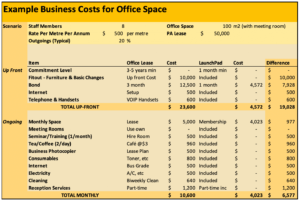
    As our article on the costs of co-working clearly shows, when everything is taken into account, and a comprehensive cost comparison is carried out, a shared office space will generally work out much cheaper compared to a permanent office rental.

    In fact, in a typical situation, savings on upfront costs of almost $20,000 can be expected, while savings on ongoing costs are estimated at around $6,500, but could come out much higher depending on the individual case.

    Pay only for the facilities and space you need. Forget about contracts and financial entanglements and get a workplace you love without the commitment, hassle and expense of a permanent office building.

    Shared Office Spaces: The Future of Work

    As the employment and economic landscapes continue to evolve and react to major world events, more flexible workspaces are required to facilitate these changes. Shared office space offers the support, adaptability, and sense of community needed for startups and small businesses to weather any storm and thrive no matter what the world throws at them.

    If you’d like to learn more about our coworking spaces book a tour today.

  • CoFounder Featured in MYOB Discussion Piece

    CoFounder Featured in MYOB Discussion Piece

    The pandemic has changed a lot of things and one might wonder, what will the workplace of tomorrow look like?


    Read through this article by the MYOB Team featuring our co-founder, Jeremy Ellis, sharing his thoughts on the future of coworking space and its role in the new normal.


    https://www.myob.com/au/blog/co-working-and-the-evolution-of-the-office-in-2021/

  • Is Flexible Office Space the Future of Work?

    Is Flexible Office Space the Future of Work?

    As the world’s economy evolves, so too, do its workers. The modern workforce is dominated by freelancers, small companies, and hybrid businesses. 

    These workers need a new kind of office space. Something dynamic and flexible that can change to fit every kind of project they work on. 

    These are problems that flexible office space is designed to solve. 

    More and more businesses are giving up commercial leases and transitioning to the use of flexible office space. Is this design the future of work? Let’s learn more about flexible office space and if it’s right for you. 

    What is Flexible Office Space? 

    Also called a shared office space or “flexispace,” flexible office space is designed to create dynamic work environments. The workspace flexes and adjusts to accommodate the changing needs of employees and their projects. 

    A flexispace consists of all the tools you find in a traditional office such as desks, chairs, computers, phones, and so on. The difference is that they are arranged in a versatile way that can be changed to accommodate workers’ needs. 

    For example, one area in a flexible office space can be a group workspace one day, a place to hold meetings or presentations the next, and a project staging area the day after that. The idea is that the workspace changes as the needs of the employees change. 

    In the business world, flexible office space is often synonymous with coworking space. Coworking spaces are buildings where several businesses rent desks, offices, and meeting rooms all under the same roof. They are designed to be versatile and change to meet the needs of cohabitation businesses and workers. 

    Flexible workspaces have been gaining popularity with freelancers and enterprise companies. By 2022, the number of flexible workspaces available in the world is predicted to double from the 26 thousand that were available in 2017. 

    Types of Flexible Office Space 

    There are many different kinds of flexible office space available. Understanding what they are will help you pick the right spaces for your needs. 

    One popular option is hot desking. Hot desking is when different people use the same desk at different times when they need it. You find an open desk, claim it, and get to work. 

    This flexibility is linked to employee innovation and cross-business collaboration. A hot desk will be equipped with everything you need to start working immediately. This includes computers, phones, power outlets, and WiFi. 

    Hot desking also gives you access to a facility’s resources. This can include meeting rooms, event spaces, client presentation rooms, and recording studios. A good coworking space will also offer IT services, printing, faxing, janitorial services, kitchen facilities, and more. 

    If you’re the kind of person who functions best with assigned seating, dedicated desks might be a better option for you. These come with all the perks and flexibility of hot desking, but you’ll be working in the same space every day. 

    These two flexispaces are a great solution to finding office space without the commitment and rigidity of long-term office leases. If you’re a freelancer, entrepreneur, or self-employed, hot desking or dedicated desks at a coworking space is one of the best ways to fight the loneliness of working at home

    Some coworking facilities also offer private or shared office space. These options are awesome if you’re working with a small team of employees. You’ll get all the perks of operating in a coworking environment while also enjoying space that is dedicated to your team and its needs. 

    Some industry leaders also offer an innovative new option, virtual offices. Virtual office business plans let you use the address of the coworking facility as your business address in marketing literature, business cards, and website. The facility will redirect physical mail to your home address and greet clients on your behalf. 

    This solution is perfect for startups. If you’re not ready to commit full-time to hot desking or shared office space, virtual offices give you an extra level of flexibility. And if you need a meeting room or desk once in a while, you can pay for it by the day. 

    Good coworking spaces are set up to give the businesses that use them as much flexibility as they need. Being knowledgeable about the different types of flexible office spaces that are out there helps you make an educated decision about which one is right for your needs. 

    Flexible Workspace Trends 

    It is undeniable that COVID-19 has changed the way we work. Many employees have enjoyed the flexibility afforded by working at home. The work from home model is especially great for disabled employees and workers who need additional accommodations. 

    Working from home is here to stay. But it doesn’t come without drawbacks. Many employees report feeling lonely and disconnected from their coworkers. People miss the social aspect of work more than anything else. 

    This is one of the biggest reasons that flex spaces are seeing a huge uptick in business. After an initial dip from the beginning of the pandemic, more and more entrepreneurs are choosing shared workspace as restrictions are lifted. 

    Flexible office space gives workers the ability to choose when to work from home and when to go into the office. It also makes it easier to maintain social distancing by offering a smaller number of desks available for use. Coworking offices will make sure that they are appropriately spaced out from each other for safety.

    Coworking spaces are also great for hybrid meetings. If half of your team is in the office and half is calling in via Zoom or Microsoft Teams, being able to rent a high-tech conference room will make your meeting go so much smoother. 

    Flexispaces free you from being tied down to real estate contracts and leases. As our world changes rapidly, your business needs room to grow and adjust. Coworking offices give you that freedom. 

    The Future of Work

    Flexible office space is the future of work. In a world dominated by startups, small businesses, and freelancers, our workforce needs more flexibility in its daily operations. 

    Coworking space is the perfect office solution. Providers make sure that you’ve got all the tools you need to get started right away. This cuts major costs like furnishing a commercial office space and IT setup. 

    The best flexible office spaces also come with serious perks. These include kitchen facilities with free refreshments, showers, indoor bike racks, gym lockers, and more. 

    The flexispace market was growing even before the pandemic. Now as more businesses take advantage of a hybrid work model that allows employees to work from home and in the office, it’s only getting bigger. 

    Hybrid workspaces are also a great way to accommodate disabled workers and workers with children. The extra flexibility gives them the space to balance their work and personal lives and increase productivity. 

    Let Your Office Space Work for You

    Flexible office space creates a collaborative environment that changes to fit the needs of its workers. It is paving the way for workers to increase both their productivity and quality of life. 

    Don’t let yourself get left behind in the office trends of the past. Find coworking spaces in your area and see what they can really do for your business.

  • Boom or bust: Co-working spaces after COVID

    Boom or bust: Co-working spaces after COVID

    The Coworking Industry in Australia has been impacted significantly through 2020 and is only now rebounding, with Victorian’s operators the last state to see a turn around.

    With businesses choosing to let their office leases lapse over the past nine months, Coworking is providing a welcome alternative to inflexible lease agreements.

    In this article by Rachel Eddie of The Age, Jeremy Ellis provides some insights – Click here to Read

  • What does a coworking space cost in Australia?

    What does a coworking space cost in Australia?

    Are you looking for a new space to work in Australia? Considering a shift from the traditional office space environment? Let’s look at what investment you might be looking at and considerations when working out what a coworking space actually costs.

    Firstly, it depends on what level of coworking services you need, there are plenty of elements to consider. Fees vary depending on the location, facilities and services provided. For example, on average, a per-desk price is around $650-750 per month for a Coworking space in Melbourne, Australia.

    Different coworking space pricing based on desk type

    Coworking services Price
    Day pass $45-$55 per day
    Part-time desk – per day $35-$45 per day
    Part-time desk – monthly membership $350-$400 per month
    Permanent desk $650-$750 per month
    Private office: up to 20 staff $160-$210 per square metre per month 
    Private office: 20-50 staff $150-$200 per square metre per month 

    Exclude GST and other charges such as insurance, deposit, telephone service, IT, printing, mailbox and other fees.

    Based on this, the average cost of a coworking space in Melbourne, Australia
    is $670 for a permanent desk

    Changes to coworking spaces – Costs in 2020, Australia

    Over recent years prices have fluctuated. It was not until mid-2019 that Melbourne coworking spaces began charging more than $700 per desk per month. The 2020 pandemic has impacted prices further. Nowadays (July 2020), prices remain typically around the $650-$750 mark. This year, prices may drop further to attract new customers. Some may offer discounts in return for long-term contracts. It’s clear there will be a trend of down-sizing office space as companies reduce headcount and implement flexible work arrangements with fewer team members in the office at a time.

    What to compare when considering coworking space costs

    It’s important to compare what they include when you consider your costs. This can be difficult because different spaces offer different inclusions. The best coworking spaces in Melbourne, Australia charge a premium based on their location, facilities and brand reputation.

    Most spaces include the following elements as part of the standard charge:

    • Wi-Fi (part time coworking desk customers may have access to a different network than permanent desk customers)
    • printing
    • basic reception services
    • shared kitchen with coffee and tea (sometimes fruit too)
    • communal dining areas.

    When it comes to other features, there’s numerous different inclusions and optional extras. Below are the questions you should ask to determine what’s included and what isn’t in your Australian coworking space.

    Questions to ask potential coworking spaces

    • Does it have an onsite or nearby café? (with decent coffee, this is Melbourne, Australia after all)
    • Does the location suit your staff and is public transport nearby?
    • Does it accommodate cyclists with bike racks, change rooms and lockers?
    • Are showers available, and towels supplied?
    • What parking is available? Is it ready to accommodate electric cars?
    • What is the Wi-Fi speed and is it reliable?
    • What are the printing capabilities and charges?
    • Is it a wheelchair friendly coworking space?
    • Do I need to be concerned about sharing a lift?
    • What about after hours if I need to work late?
    • What are the charges for faxing, scanning and binding?
    • Do you get any listings in business directories or other similar benefits (such as the opportunity to present to other tenants)?
    • What is stocked in the kitchen? Does it include tea, coffee, biscuits/snacks and fruit?
    • Will I be locked-in to an inflexible contract?
    • Are there any hidden costs in the monthly outgoings?
    • Do you have access to meeting rooms for hire, ideation spaces and recreational spaces?
    • Do you have access to event spaces and support when organising events?
    • Are there spaces suitable for recording podcasts or Zoom meetings?
    • Is it family friendly, with baby change facilities?
    • Is it pet friendly?
    • What reception services are provided? Will you get support for couriers and mail management?

    What about cheap coworking spaces? What’s the difference?

    If you are prepared to sacrifice services and convenience, you can secure locations in Australia at a cheaper rate. For a permanent desk, the lower rate is typically $600 per month. Locations in the outer suburbs of Melbourne or further from public transport tend to be cheaper. However they are not as convenient for staff who may incur travel time and expenses to get to work. Coworking spaces can also be cheaper if they have fewer facilities, such as meeting rooms or on-site kitchen. Or perhaps there’s fewer services, such as reception, telephone service or mail service. But, you may end up with out-of-pocket costs, thus negating any savings.

    What does a permanent desk cost?

    Most scaleups or downsizers are looking for permanent desks in Australia. While more expensive than hot desk arrangements, tenants get the benefits of shared office space with the convenience of a permanent space for each staff member. As with other coworking office spaces in Melbourne, permanent desk charges vary. A simple desk with few services, facilities in an outer-suburb location could start from $650 per month. While an CBD or inner-city, exclusive space with strong brand identity, extensive facilities and services can charge up to $750 per month. The average rate tends to be about $690 per month for a central location, variety of on-site facilities and services.

    What’s the vibe of the place?

    You want to compare the intangibles too. Is it a space you can see your team enjoying? Does it have a friendly, productive atmosphere? What are the hosts doing to encourage networking and socialising by the way of events, workshops and lectures? You want to feel that you’re in a space that facilitates growth, productivity and community. You can’t put a price on those intangible factors. But they make a difference to your success in the space. Some spaces are more creative and artistic, suitable for designers, freelancers and creatives. Others are geared towards tech, corporates, scale ups or startups. So think about how you’d fit alongside the other tenants.

    Comparing coworking to office rentals

    You may be comparing your shared coworking space in Melbourne, Australia to getting a private permanent office space or serviced office space. Here’s where it can get complicated. Many of the services provided in a shared office space aren’t included when you rent an office. So on paper, the office rental charge may be lower.
    For example, with an office space you need to factor in these expenses:

    • Office manager: someone to get the printer fixed, call the plumber for the blocked loo, grab coffees, wipe down the kitchen bench (and leave passive-aggressive signs) and handle reception duties
    • Utilities: Wi-Fi, water, electricity and gas
    • Cleaning: Can vary depending on size, but that large meeting room needs regular cleaning (whether you use it or not)
    • Fitout: when you move in, you potentially need to setup the kitchen, bathroom, meeting rooms, desks and storage

    Cost Comparison – Lease Vs LaunchPad

    Example Business Costs for Coworking space vs traditional office space

    Easy mistakes to make when comparing coworking spaces costs

    It can be easy to underestimate what you need and make a decision based on price alone. If you are a solopreneur, you can easily decide to try out the space for a few months. But, if you are moving your team of ten or more staff into a space, undertaking a brief trial is rather more difficult. You don’t want to realise after three months that the space isn’t working for you or the costs aren’t what you imagined.

    The common mistakes people make include:

    • Not accurately calculating how often they need meeting space. This means they either pay for a space they rarely use, or get stung with excessive meeting room charges each month.
    • Getting a space that doesn’t allow for future growth. This means quickly outgrowing the location and cramming staff into a too-small space which impacts productivity and morale.
      NOTE: A good coworking space builds this flexibility into the plan and has space to adapt the business as needed.
    • Getting a space that is too big. This means paying for desks for part-time staff that could be shared. Or paying for a larger office in anticipation of future growth that takes longer than expected. As above
    • Not considering the price of setting up a coworking space. While this is far less expensive than fitting out a private rental space, there are charges involved such as setting up IT, moving staff, relocating your address on your printed materials, updating online listings (Google My Business, online directories) and getting staff moved to the new location in a seamless manner.
    • Not considering the facilities you’ll actually use. Some tenants of coworking spaces in Melbourne, Australia are charged for numerous extras that they rarely use. A more simple solution without unnecessary frills may be more cost-effective in the long run.